
Yavapai County Wanted Campaigns
The sheriff's office has no fixed-size “Top Ten” board. There is no posted schedule for updates either. What the county has instead is Yavapai Silent Witness. That program runs selective campaigns for individual fugitives and unsolved cases. It sits inside the Yavapai County Sheriff's Office and partners with local police and media outlets. A campaign may stay online long after its first release, so treat nothing you see as a full list of active county warrants.
What a notice contains varies. Expect a name, a photo, the alleged conduct, agency or case details, and tip instructions. Not every appeal has all of it. The picture might be a booking photo, an older agency image, or something else entirely, so label it only the way the notice itself does. No reliable count of wanted persons exists. There is no posting rhythm either. A live campaign simply asks the public for help with one specific matter.
Yavapai County wanted campaigns publicize people sought by law enforcement, and each notice carries its own agency details and case reference.
Yavapai County Wanted Notice Fields
Silent Witness posts are campaign records. They are not standardized jail profiles. Read only what the notice actually supplies, and resist the urge to fill gaps from a same-name web result. A pictured person has not necessarily been booked at the Yavapai County Detention Center. The common elements below explain what each notice may contain and how to treat it.
| Field | What it may show |
|---|---|
| Name or identifier | The person named in that specific campaign; confirm all identifiers before acting on a same-name result. |
| Photograph | An image chosen for the appeal, which is not necessarily a current jail booking photo. |
| Charge or case basis | The conduct or case described by the publishing agency, still an charge rather than a disposition. |
| Agency or case detail | The office investigating the matter and, when supplied, a case reference that can help route a tip. |
| Tip instructions | The Silent Witness contact method and any campaign-specific information requested from the public. |
| Reward language | Whether information leading to a qualifying felony arrest may be eligible for a cash reward. |
Case details can shift as matters move forward. The court docket and its filed documents are what show real status, not the wording of a campaign. Charges may be filed, changed, dropped, or resolved. That formal outcome is called a disposition. Checking it keeps an old appeal from being read as something current.
Note: A visible campaign is a request for information, not proof that the named person is currently in YCSO custody.
Browse Yavapai County Wanted Fugitives
The safest way to use a wanted campaign is to preserve its official context. Open the current Silent Witness site, note the posting agency and case details, and use the campaign’s own tip channel. Do not copy the photo into a private gallery or circulate an edited version that drops the allegation date and source. A face alone is not a reliable identifier, and an old post may not reflect the present court or custody state.
- Open the official-linked Silent Witness campaign index and select the relevant wanted-fugitive or unsolved-case notice.
- Read the full notice, including the agency, date, charge, case reference, and tip directions that are actually shown.
- Compare only facts you personally know. Do not infer identity from a similar face, name, neighborhood, or old profile.
- If the information may be useful, send it through Silent Witness or the identified law-enforcement agency. Call 911 only for immediate danger.
- After a reported capture, use the Yavapai County custody and booking paths to distinguish a current roster row from the later court case.
The Yavapai Silent Witness home page carries the official-linked appeals and tip channels used across the county.
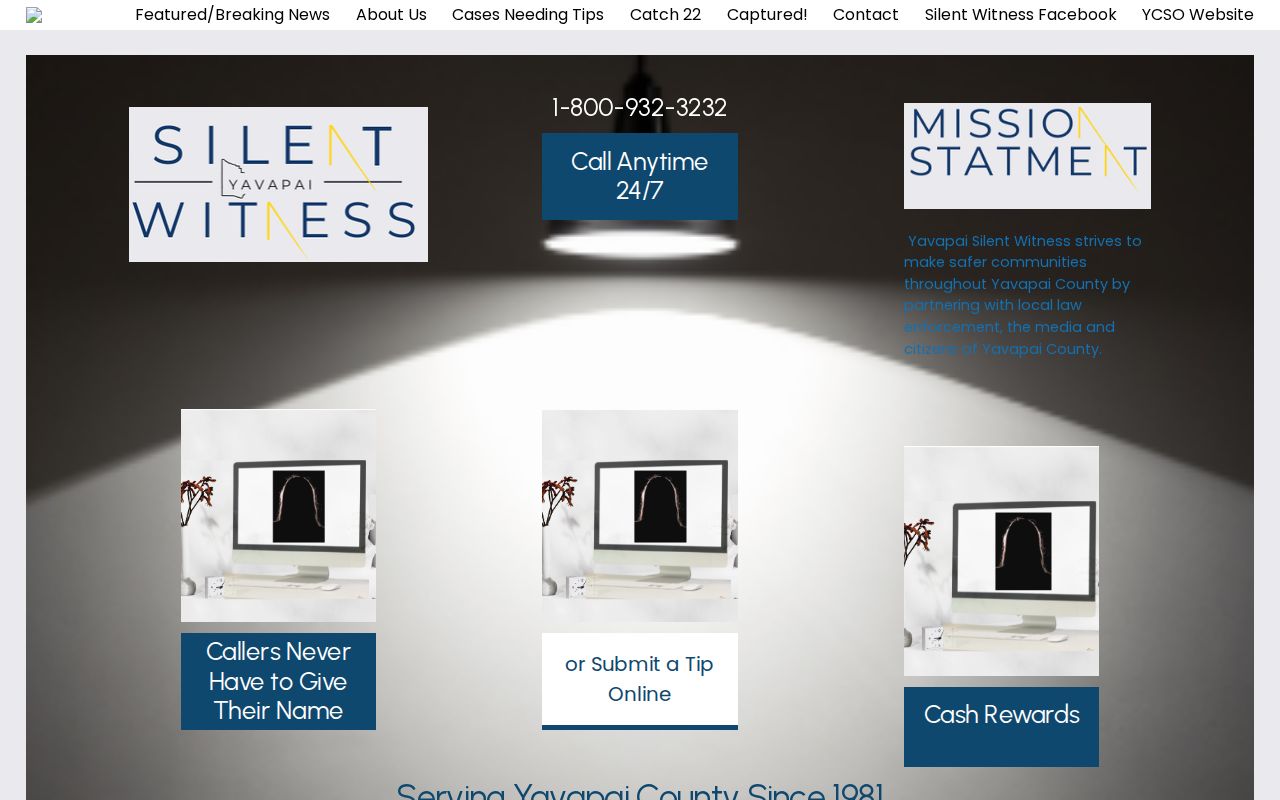
That page documents the campaign channel without rehosting anyone's face or building a local photo list.
Yavapai County Wanted Tips
The Silent Witness tip line never closes, and callers stay nameless. The program hands each caller a four- or five-digit control number, which becomes the link to the tip and to any later reward inquiry. Information that leads to a felony arrest may earn a cash reward, though eligibility is never automatic. Reward administration keeps its own weekday schedule. The tip line itself answers around the clock.
Yavapai Silent WitnessAnonymous tip line: 1-800-932-3232
Tips accepted: 24 hours a day
Reward administration: Monday–Thursday, 8 a.m.–4 p.m.
Silent Witness contact page
Guard that control number and follow whatever instructions the program gives you. Arizona law shields the identifying portions of anonymous silent-witness records under A.R.S. § 12-2312. The YCSO Silent Witness referral confirms the county connection.
Safety first: Never approach, follow, confront, or try to detain someone shown in a wanted campaign; send what you know to law enforcement.
Check Yavapai County Warrants
A warrant is a court order authorizing a stated law-enforcement action. Here is the catch in Yavapai County. YCSO's parent Community Resources summary still mentions a “Warrant Search,” yet the live Crime Prevention page offers no working warrant-query portal. Do not mistake stale navigation for an active database. A Silent Witness campaign is not a warrant index either.
The Arizona Public Access Case Lookup can supply a case lead for participating courts. It is not a guaranteed warrant database; its data updates weekly, and some matters are excluded or sealed. Court calendars occasionally show warrant-related settings too. They fall well short of a full registry. When you suspect a warrant applies to you, the issuing court or an attorney is the sound confirmation route.
- Gather the exact legal name and any known case number or issuing-court information. Avoid relying on a name match alone.
- Search Public Access Case Lookup for a possible case lead. Compare court, filing date, party details, case type, and event history.
- Contact the court of record or the Yavapai County Clerk of Superior Court to confirm the official file and current instructions.
- If the matter may concern the person making the inquiry, contact counsel or the issuing court and arrange a lawful response. Do not rely on advice about avoiding contact.
- After any appearance, review the filed minute entry or judgment for the actual outcome rather than treating the old warrant notation as final.
The official Arizona court lookup screen below illustrates the lead source and its limits.
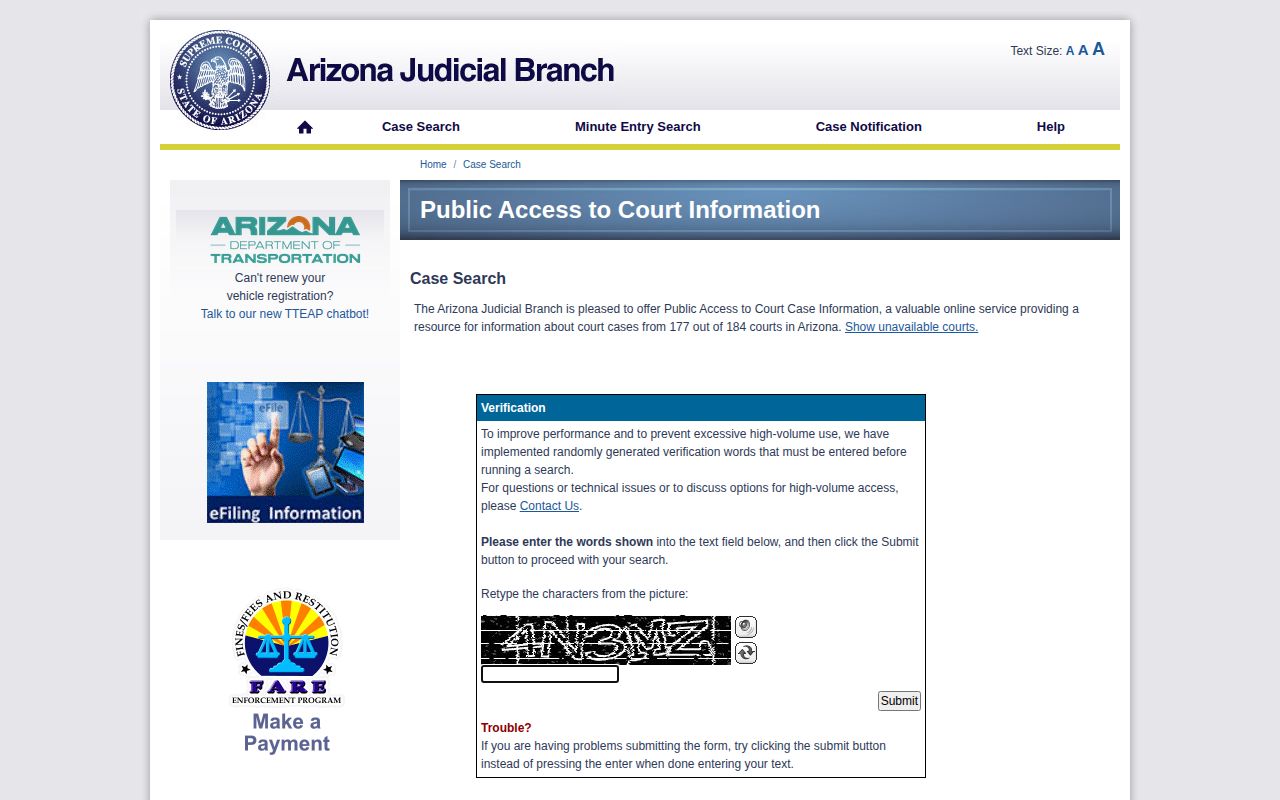
The court search can point you toward a file. Confirmation still has to come from the issuing court or its official record.
Note: An empty online result does not prove no warrant exists, since weekly updates, spelling differences, exclusions, and court coverage can all affect what the search returns.
Yavapai County Warrant Types
Warrant labels matter more than people think. Who issued the order can shape how it gets resolved and which office you call. Broad definitions help. Still, the public case index won't always spell out every enforcement detail. Only the court handling a Yavapai County matter can say how it applies to one person.
| Type | General meaning | Safe confirmation path |
|---|---|---|
| Arrest warrant | A judge authorizes arrest in connection with an alleged offense or filed matter. | Issuing court or counsel, using the case number when known. |
| Bench warrant | A court issues an order tied to a missed appearance or failure to follow a court direction. | The court that issued the order or an attorney. |
| Search warrant | A judge authorizes a defined search for specified evidence; it is not a public wanted-person list. | The filed case record when public, or counsel for a person directly involved. |
| Probation-related warrant | An order may arise from an alleged supervision violation. | The supervising authority, issuing court, or counsel. |
An old docket line can mislead. It may show an order existed without confirming the warrant is still active today. The same caution applies to custody. Getting out of YCSO custody doesn't mean the charge went away. A current court record keeps warrant status, custody, and case outcome distinct from one another, which is exactly why it beats guessing from fragments.
Yavapai County Wanted System Limits
The tools people often assume exist here mostly don't. YCSO has no verified jail-search or booking-photo mobile app. Smart911/RAVE and Genasys handle emergencies and evacuations, VINE sends custody-change alerts, and Securus covers inmate communication. None of them checks Yavapai County warrants or lists wanted fugitives. YCSO news releases are selective and event-driven too, so a story about one operation is not a county-wide list and never replaces the court record.
These records answer different questions, and blurring them causes most of the confusion. Silent Witness collects tips. A court confirms its own warrants. The YCSO roster covers only people currently held in county detention, a booking file logs jail intake, and a court file shows the charges and how the case resolved. Someone missing from the roster may have been released, transferred, held elsewhere, or listed under a different spelling. A warrant can also exist with no jail row at all. Going the other way, a roster row doesn't prove the person matches the campaign you first saw. Match the inmate number, booking date, location, and exact name, then follow the court case number for the filed proceeding.
When timing matters, note each source's date or timestamp, since Silent Witness posts, court-index entries, and jail rows speak from different moments. Save the campaign's agency and case details for a tip, but let law enforcement test what you send. Worried about a warrant in your own name? Give the court or your counsel the case reference and ask about lawful next steps. These routes cut confusion without inviting confrontation or delay.
For direct questions, contact the Yavapai County Sheriff's Office at 255 E. Gurley St., Prescott, AZ 86301, or call 928-771-3260. The official site is ycsoaz.gov. Emergencies go to 911, anonymous tips go to Silent Witness, and personal warrant concerns go to the court or counsel.